Showing posts with label Lisbeth Eng. Show all posts

Sunday, March 8, 2015

Deutschland, Deutschland Über Alles? The Denazifacation of a National Anthem


The 1958 film, The Young Lions, opens in pre-World War II Germany. American tourist Margaret Freemantle enjoys the romantic attentions of her German ski instructor, Christian Diestl. She is disturbed, however, when Christian defends Hitler as a symbol of hope for Germany. Disheartened, she turns from Christian and walks away, while in the background, guests at the ski lodge are heard singing the first lines of the German national anthem. Here, the song is emblematic of the German people’s acceptance of Nazism, and its ultimate goal of world supremacy. Other World War II films contain similar scenes with similar implications.

In 1952, the Federal Republic of Germany established the third stanza of “Das Deutschlandlied” – “The Song of Germany” – as the national anthem. In effect, the first and second stanzas of the original song were eliminated from official use. Part of the decision to banish the first verse, which begins with, “Deutschland, Deutschland über alles, über alles in der Welt,” was due to its association with the Nazis, and the supposed implication that “Germany, Germany above everything, above everything in the world” endorsed Hitler’s goal of world domination. In fact, in 1945, the victorious Allies banned its use, along with other perceived Nazi symbols. However, that interpretation ignores the historical context and true meaning behind the words.

The lyrics of “Das Deutschlandlied” were penned in 1841 by German poet August Heinrich Hoffman von Fallersleben with a completely different aim in mind. At that time in history, Germany was not a nation, but a conglomeration of disparate principalities, duchies and kingdoms. Hoffman’s plea to the monarchs of these small states was to put the ideal of a united Germany above their individual sovereignties.

In the first verse of his poem, Hoffman outlines the physical boundaries of his envisioned German nation. The four rivers mentioned (known in English as the Meuse, Memel, Adige and Belt) defined Germany’s borders at that time, clearly expressing that instead of conquering other nations, Germans should focus on building their own. World domination could not have been further from his mind:

Deutschland, Deutschland über alles,
Über alles in der Welt,
Wenn es stets zu Schutz und Trutze
Brüderlich zusammenhält.
Von der Maas bis an die Memel,
Von der Etsch bis an den Belt,
Deutschland, Deutschland über alles,
Über alles in der Welt!

Germany, Germany above everything,
Above everything in the world,
When for protection and defense, it always
takes a brotherly stand together.
From the Meuse to the Memel,
From the Adige to the Belt,
Germany, Germany above everything,
Above everything in the world!

Hoffman’s plea is not so different from the ideal put forth in our own patriotic song, “America the Beautiful,” which defines our country’s boundaries as spanning “from sea to shining sea!”

The final verse of “Das Deutschlandlied,” now sung at governmental and civic occasions, denotes Hoffman’s vision of a free and united Germany:

Einigkeit und Recht und Freiheit
Für das deutsche Vaterland!
Danach lasst uns alle streben
Brüderlich mit Herz und Hand!
Einigkeit und Recht und Freiheit
Sind des Glückes Unterpfand;
Blüh' im Glanze dieses Glückes,
Blühe, deutsches Vaterland!

Unity and Justice and Freedom
For the German Fatherland!
Let us all strive for this purpose
Brotherly with heart and hand!
Unity and Justice and Freedom
Are the Pledge of Happiness;
Bloom in the Glow of Happiness,  
Bloom, German Fatherland!

If you’re wondering what happened to the second stanza, it extols the virtues of German “women, loyalty, wine and song,” noble sentiments perhaps, though a bit old-fashioned, and possibly a touch condescending from a female perspective.

Germany’s decision to eliminate the first stanza from their national anthem is understandable; all possible associations to Nazi aggression must be erased, even if the words themselves are benign. Borders have shifted as well, and Germany’s territory has contracted since Hoffman’s time, making his reference to the four rivers now geographically inaccurate.


The final verse of Hoffman’s poem resonates in a reunified Germany, with its lofty aspirations of “Unity and Justice and Freedom.” Perhaps prophetically, Hoffman’s vision is fulfilled in today’s united and democratic German republic.

Sunday, August 22, 2010

Heart Lessons


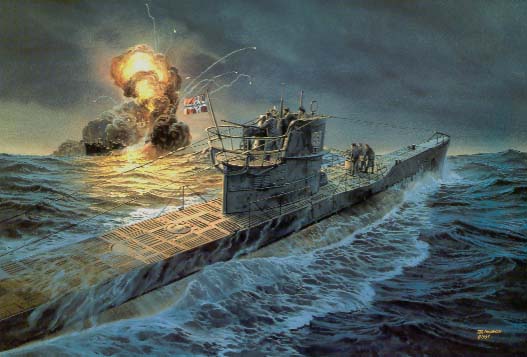
Forgiveness. The theme of Andy Andrews’ difficult-to-categorize work, The Heart Mender, pervades the story of a German submariner and an American waitress set in World War II era Alabama. The back cover of the book defines it as “SELF-HELP/Motivational/Inspirational”. These are genres I generally do not read, but when a friend alerted me to the recent publication of a book involving a romance between a German WWII sailor and an American woman, I was too intrigued to resist.

The book purports to be a true story and is divided into three sections. It begins as a contemporary, factual narrative. Mr. Andrews describes how, while digging up a tree stump in his own backyard on the Gulf coast of the southern US, he accidently unearths a rusty can containing a number of unusual artifacts. Through careful research, he is able to identify the anchor-embossed buttons, Iron Cross medal, and silver badge depicting an anchor curiously entwined with the initials “UB” (later identified as U-boat). Also included in the can are three old photographs – one of a sailor, another of a couple with a small child and the last a group of naval personnel and military officials, including Adolf Hitler, the only individual in any of the photos whom Mr. Andrews can identify.

The middle section of the book, by far the longest, reads like a novel and is set in 1942 Alabama. The main characters are Helen Mason, the embittered widow of an American Army Air Force officer, and Josef Bartels Landermann, the German U-boat officer whom Helen discovers near death, washed up on the beach near her cottage.

At times while reading The Heart Mender, I didn’t know quite what to make of it. Though very much caught up in the story of Helen and Josef, I would occasionally glance at the back cover, wondering how this book fit into the category of “SELF-HELP/Motivational/Inspirational”, which the publisher had placed it in. I primarily read straight fiction or non-fiction; this book read like a fusion of both, with something else, a genre I am not familiar with, mixed in. In a sense, the lack of a “Romance” designation enhanced my enjoyment; I didn’t know whether to expect a happy ending and that mystery propelled me to excitedly read on, as the characters I had come to care about faced wrenching and even life-threatening plot twists. Romance readers are guaranteed a happy ending, though death, destruction and despair often loom, apparently inescapably. One of the challenges for a romance novelist is to keep the reader wondering, if just for a moment, if she will get that happy ending she has been promised.

To sum up the thrust of Mr. Andrews’ book, I quote part of the back cover blurb: “The Heart Mender is a story of life, loss, and reconciliation, reminding us of the power of forgiveness and the universal healing experience of letting go.” Though primarily drawn to the book by it’s WWII story, involving a romance between enemies (much like my soon-to-be-released novel), I was intrigued by the theme of forgiveness and reconciliation. As a writer of World War II romance, I find myself in the paradoxical position of spinning a tale of both love and war. I consider myself a peace-loving person. I wouldn’t call myself a pure pacifist though; in the most extreme cases, aggression is sometimes the only response to aggression, when all avenues for peaceful resolution have been exhausted. So why was I moved to write a book immersed in themes hate, as well as of love? And why do I blog about it? Though I deal with the subject matter differently than Mr. Andrews does (after all, he writes “Inspirational” and I write “Romance”), I hope readers will come away from my novel with a similar message. Years ago, when discussing my book with my sister Stephanie (one of my manuscript’s early critiquers) she and I both concluded that its themes were love and forgiveness. My personal journey in writing In the Arms of the Enemy, as well as “World War II…with a German accent,” has revealed an overriding ethic: that even amidst the worst of human experience and inhuman behavior, I refuse to give up hope of redemption – redemption not in a religious sense, but in a moral one.

Forgiveness. This powerful, life-altering phenomenon stirred my heart through The Heart Mender, and the thrilling true story drove my interest. Though this is not a genre I would normally pluck from the bookshelf, I came away moved and enchanted. I loved Mr. Andrews’ characters – real people whose names have been altered – and was satisfied to learn in the third and final section of the book their ultimate fates. Mr. Andrews had the good fortune to actually track down and interview some of them, enabling him to piece together the mystery of how German World War II artifacts, secreted for nearly 60 years, ended up in his back yard on the Gulf coast of the United States. Had it not been for that pesky tree stump, this story would never have been known or told. I encourage you to read it, and dare the cynical among you not to be moved.