Wednesday, December 20, 2023

My "Weihnachtsgeschenk" to you!


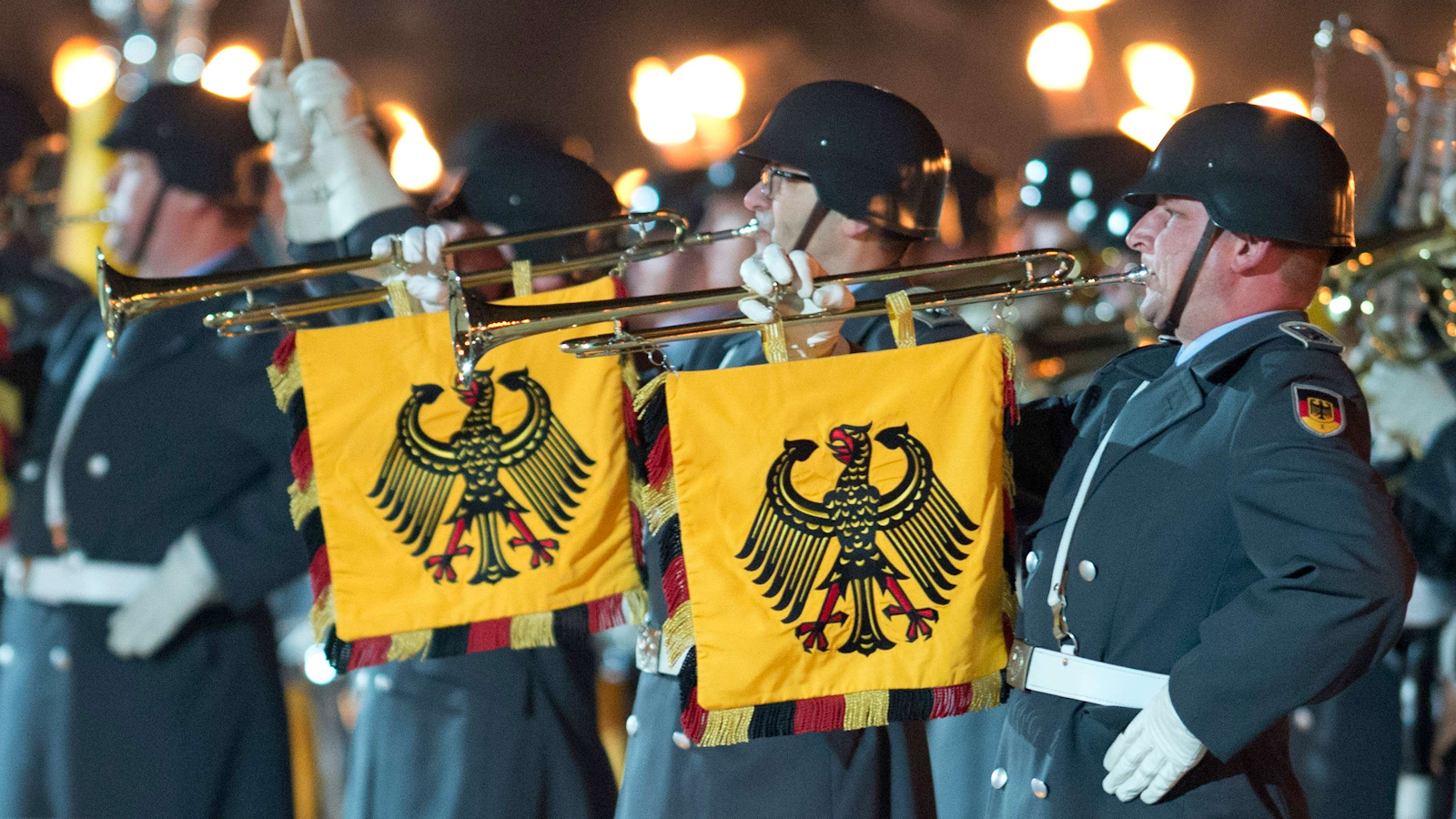
You don't have to understand the German language to appreciate this video of the "Großer Zapfenstreich" ceremony honoring Angela Merkel. It was the Bundeswehr's formal farewell to Germany's first female chancellor, aired live on German TV. Though an American, I have great respect for Frau Merkel. Her center-right politics don't exactly align with mine, but during her tenure at Germany's helm, she proved herself a formidable and compassionate leader, and arguably the world's most powerful and influential female head of government in recent memory. (I admire the late Queen Elizabeth II for similar reasons, and some might place her just ahead of Frau Merkel in this category.)

The video is rather long, but you might enjoy playing it as "background music" while wrapping gifts (in case you need a break from ‘All I Want For Christmas Is You’ by Mariah Carey or ‘Last Christmas’ by Wham).

You might especially enjoy it if you like military music, the German language, or "pomp and ceremony." I'll concede that it has little or nothing to do with "World War II... with a German accent," as it is performed by representatives of the Bundeswehr (today's German armed forces) and not the Wehrmacht (Germany's armed forces during the Second World War). 

Consider this my holiday gift to you, my faithful blog followers!


Wednesday, October 4, 2023

Marching for love and war


Have you ever watched a War World II movie and noticed the smartly uniformed German soldiers, marching in flawless unison, intoning a thrilling military song? They may even be “goose-stepping,” their black boots and steel helmets gleaming, with perhaps a stony glint in their eyes? The iconic scene from the film Battle of the Bulge comes to mind, though technically, the soldiers are not so much marching as stomping. You can find a translation of this Wehrmacht march, “Panzerlied” (“Tank Song”) here. Leading his troops in the film is the devilishly handsome, blond-haired and blue-eyed Robert Shaw, who conveys a model, if somewhat stereotypical, Aryan commander.

An even more chilling march is “SS Marschiert in Feindesland,” also known, fittingly, as “The Devil’s Song.” If there were any doubt that this SS march proclaims adherence to Nazism, the lyrics make it crystal clear: “We fight for Germany. We fight for Hitler.”

But must military marches always be so belligerent? Are young men only inspired by love of comrades, country and Führer? As it turns out, soldiers on both sides of the conflict attempted to lift each other’s spirits with reminders of something closer to home and more universal: the girls they left behind.  One such march is “Erika.” Published in 1938, it is primarily associated with Nazi Germany, though the words themselves are as benign as the tune is invigorating. (In German, “Erika” is a common female name, as well as the word for heather.) Similarly amorous lyrics can be heard in the marching song "Im Wald, im grünen Walde" ("Lore Lore Lore"). I can attest to the addictiveness of the catchy melody (it’s been playing in my head all day), and the lyrics – “Beautiful girls are everywhere” – are sure to put a smile on even the most battle-weary soldier’s face. This folk song has been recorded by singers such as Heino and Edith Prock, and is not known exclusively as a soldier’s march.

If you’ve been following this blog, you may have noticed that this is the third out of my last four posts that deal explicitly with music. (The fourth, my most recent post “From Wehrmacht to Bundeswehr – Crosses, Eagles and Flames,” while addressing various military themes, includes a link to the ceremonial march of the Bundeswehr, the “Großer Zapfenstreich.”) The most recent post on my other blog, “Musings and discoveries,” is also related to music, specifically to national anthems. I don’t think this is a coincidence. There is something alluring, even mesmerizing, about music, which has surely inspired me to write about it. For centuries, the whole world over, militaries have taken full advantage of the intoxication of music. It spurs their troops into battle, and soldiers carry on as death and destruction loom.


Tuesday, September 19, 2023

From Wehrmacht to Bundeswehr – Crosses, Eagles and Flames


An insignia can hold immediate, visceral power. Just think how the swastika instantly evokes bigotry and hatred in general, and more specifically, anti-Semitism and the Nazi regime. Unfortunately, it is still in use today by neo-Nazis. In 1920, Hitler appropriated the ancient symbol, associated for millennia with the eastern religions of Hinduism, Buddhism and Jainism, for his newly-formed Nazi Party. The emblem has been banned in Germany since 1945, and can only be used there for educational purposes. The swastika has a fascinating history, which you can dive into here.

Other symbols have long been associated with Germany, and with many of its precursor states, including the Holy Roman Empire and Prussia. Teutonic militaries awarded soldiers the Iron Cross (Eisernes Kreuz) for battle-won honors, and it is used today as the emblem of the Bundeswehr. The coat of arms of Germany, the Bundesadler (Federal Eagle), is used on governmental and military standards. According to Wikipedia (which we know is never wrong) it is the oldest national symbol used in Europe.

Unless you’re a history buff or Germanophile like me, you may be perplexed by images of the Bundeswehr marching with flaming torches. Tiki torches were infamously used by anti-Semites and white nationalists in the “Unite the Right” rally in Charlottesville, Virginia in 2017. These improvised torches were reminiscent not only of the Ku Klux Klan, but of Nazis as well. I can well understand the primal reaction to a torch-carrying mob, and the fear it rouses. However, today’s Großer Zapfenstreich ceremony is the highest tribute bestowed on individuals such as the German chancellor, president and defense minister. For those not prejudiced by the misuse/abuse of the spectacle by ignorant Nazi-wannabes, it is a thrilling parade, especially when accompanied by such stirring melodies as Beethoven’s “Yorckscher Marsch,” the "Großen Zapfenstreich Marsch,” or the national anthem of Germany, “Das Deutschlandlied.” (I wrote a post on this blog many years ago discussing the history of the German national anthem. You can also visit my other blog, “Musings and discoveries,” to read my recent post on national anthems, which has links to various anthems, including Germany’s.)

The history of World War II in Germany is a painful one, especially for the victims of Nazism and their descendants. It was arguably the darkest period of the twentieth century, with civilian and military deaths numbering in the tens of millions. I sometimes pause before I relay the title of this blog, “World War II…with a German accent,” knowing that those two concepts put together immediately arouses negative connotations for many people. In fact, when I started this blog in 2009 to promote my romance novel, IN THE ARMS OF THE ENEMY, I included the disclaimer, “The purpose of this blog is historical, not political,” right at the top of the page.

Symbols can be potent, and it may be difficult for many to overcome their initial reactions to crosses, eagles and flames, and to see the meaning behind the emblems. But I advocate that we try, learning as much as we can of the histories and cultures of other nations. I suggest this for our personal edification, and for international goodwill, as well.


Sunday, April 23, 2023

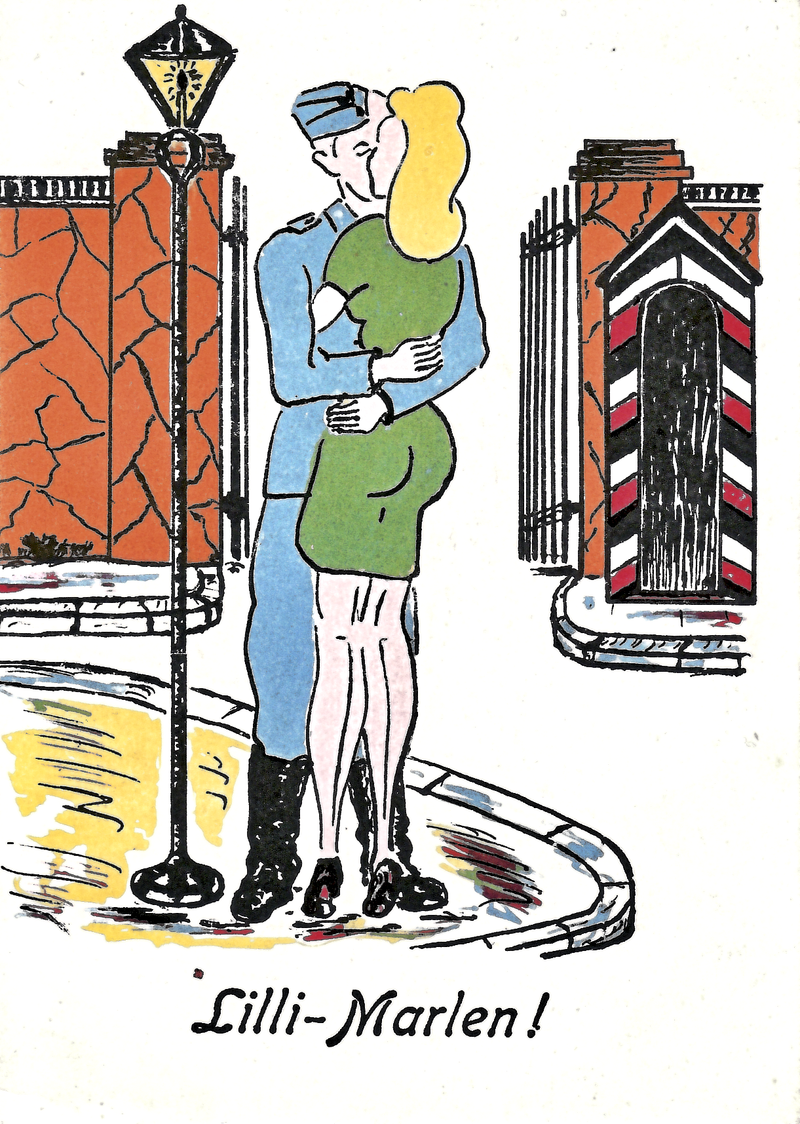
Lili Marleen

Propaganda postcard of the German Wehrmacht's postal service in Paris, 1942, with Lili Marleen motif


There were few things that Axis and Allied combatants agreed on during World War II. From their political ideologies to their human rights records to their respective interpretations of “total war,” German fighting men felt little kinship with their American, British or French counterparts, besides perhaps the brotherhood of soldiery.


Remarkably, there was one common thread, one poignant and emotional touchpoint, where the warring sides intersected, nurtured by the universality of music: the song “Lili Marleen.” Popular with Axis and Allied troops alike, the original German lyrics, and their translations into English, French and Italian, struck a chord with military men of various nationalities:


Vor der Kaserne
Vor dem großen Tor
Stand eine Laterne
Und steht sie noch davor
So woll'n wir uns da wieder seh'n
Bei der Laterne wollen wir steh'n
Wie einst Lili Marleen.

Unsere beide Schatten
Sah'n wie einer aus
Daß wir so lieb uns hatten
Das sah man gleich daraus
Und alle Leute soll'n es seh'n
Wenn wir bei der Laterne steh'n
Wie einst Lili Marleen.

Underneath the lantern,
By the barrack gate
Darling I remember
The way you used to wait
T'was there that you whispered tenderly,
That you loved me,
You'd always be,
My Lilli of the Lamplight,
My own Lilli Marlene

Time would come for roll call,
Time for us to part,
Darling I'd caress you
And press you to my heart,
And there 'neath that far-off lantern light,
I'd hold you tight ,
We'd kiss good night,
My Lilli of the Lamplight,
My own Lilli Marlene


The 1915 poem by Hans Leip, an Imperial German Army soldier, was later set to music by Norbert Schultze, and first recorded by Lale Andersen in 1939. The song was translated into English by Norman Baillie-Stewart, a former British army officer and Nazi sympathizer, who assisted the German propaganda machine. Other English-language versions were published, and Andersen recorded the Baillie-Stewart translation in 1942. Entertaining both Axis and Allied troops, Andersen's English recording earned a gold disc with over one million sales. Besides Andersen, the song was recorded by other artists, and in the 1961 film Judgment at Nuremberg, Marlene Dietrich's character translates the song for Spencer Tracy's, telling him that the German lyrics are "much sadder" than the English.

Troops on both sides of the war listened to recordings broadcast by German- and English-language radio stations. Neither German High Command nor the Allied authorities officially sanctioned the song, and top brass in each camp had tried to ban it at one time or another. On the German side, Joseph Goebbels reportedly hated the song, while Erwin Rommel asked that it be played more often. "Lili Marleen" became a sensation, and combatants from warring nations embraced the song as their own.

The forlorn soldier or sailor, far from home, bereft of compassion and tenderness, yearns for many of the same comforts as does his counterpart across no man's land. Just like air and water, food and shelter, all people crave love and affection, regardless of nationality or creed. It is what makes us human, what separates us from automatons. While music purportedly can "soothe the savage breast," it also reminds us of what we have in common, and perhaps has the power to calm the raging hearts of warriors, and inspire our shared humanity.

Sunday, March 8, 2015

Deutschland, Deutschland Über Alles? The Denazifacation of a National Anthem


The 1958 film, The Young Lions, opens in pre-World War II Germany. American tourist Margaret Freemantle enjoys the romantic attentions of her German ski instructor, Christian Diestl. She is disturbed, however, when Christian defends Hitler as a symbol of hope for Germany. Disheartened, she turns from Christian and walks away, while in the background, guests at the ski lodge are heard singing the first lines of the German national anthem. Here, the song is emblematic of the German people’s acceptance of Nazism, and its ultimate goal of world supremacy. Other World War II films contain similar scenes with similar implications.

In 1952, the Federal Republic of Germany established the third stanza of “Das Deutschlandlied” – “The Song of Germany” – as the national anthem. In effect, the first and second stanzas of the original song were eliminated from official use. Part of the decision to banish the first verse, which begins with, “Deutschland, Deutschland über alles, über alles in der Welt,” was due to its association with the Nazis, and the supposed implication that “Germany, Germany above everything, above everything in the world” endorsed Hitler’s goal of world domination. In fact, in 1945, the victorious Allies banned its use, along with other perceived Nazi symbols. However, that interpretation ignores the historical context and true meaning behind the words.

The lyrics of “Das Deutschlandlied” were penned in 1841 by German poet August Heinrich Hoffman von Fallersleben with a completely different aim in mind. At that time in history, Germany was not a nation, but a conglomeration of disparate principalities, duchies and kingdoms. Hoffman’s plea to the monarchs of these small states was to put the ideal of a united Germany above their individual sovereignties.

In the first verse of his poem, Hoffman outlines the physical boundaries of his envisioned German nation. The four rivers mentioned (known in English as the Meuse, Memel, Adige and Belt) defined Germany’s borders at that time, clearly expressing that instead of conquering other nations, Germans should focus on building their own. World domination could not have been further from his mind:

Deutschland, Deutschland über alles,
Über alles in der Welt,
Wenn es stets zu Schutz und Trutze
Brüderlich zusammenhält.
Von der Maas bis an die Memel,
Von der Etsch bis an den Belt,
Deutschland, Deutschland über alles,
Über alles in der Welt!

Germany, Germany above everything,
Above everything in the world,
When for protection and defense, it always
takes a brotherly stand together.
From the Meuse to the Memel,
From the Adige to the Belt,
Germany, Germany above everything,
Above everything in the world!

Hoffman’s plea is not so different from the ideal put forth in our own patriotic song, “America the Beautiful,” which defines our country’s boundaries as spanning “from sea to shining sea!”

The final verse of “Das Deutschlandlied,” now sung at governmental and civic occasions, denotes Hoffman’s vision of a free and united Germany:

Einigkeit und Recht und Freiheit
Für das deutsche Vaterland!
Danach lasst uns alle streben
Brüderlich mit Herz und Hand!
Einigkeit und Recht und Freiheit
Sind des Glückes Unterpfand;
Blüh' im Glanze dieses Glückes,
Blühe, deutsches Vaterland!

Unity and Justice and Freedom
For the German Fatherland!
Let us all strive for this purpose
Brotherly with heart and hand!
Unity and Justice and Freedom
Are the Pledge of Happiness;
Bloom in the Glow of Happiness,  
Bloom, German Fatherland!

If you’re wondering what happened to the second stanza, it extols the virtues of German “women, loyalty, wine and song,” noble sentiments perhaps, though a bit old-fashioned, and possibly a touch condescending from a female perspective.

Germany’s decision to eliminate the first stanza from their national anthem is understandable; all possible associations to Nazi aggression must be erased, even if the words themselves are benign. Borders have shifted as well, and Germany’s territory has contracted since Hoffman’s time, making his reference to the four rivers now geographically inaccurate.


The final verse of Hoffman’s poem resonates in a reunified Germany, with its lofty aspirations of “Unity and Justice and Freedom.” Perhaps prophetically, Hoffman’s vision is fulfilled in today’s united and democratic German republic.

Saturday, July 19, 2014

WELTMEISTER! Reflections of a German-American on a World Cup and a World War


My jubilation at Germany’s fourth World Cup title is tempered by the fact that I was born and raised in America. Of course, I also rooted for Team USA but secretly prayed that the two teams would avoid a head-to-head confrontation in the Final – the consequential strain on my loyalties would have been too much to bear. (It was a very remote possibility had USA survived the knockout stage.)

I prepared for the Final by donning my Deutscher Fußball-Bund t-shirt and fan scarf and painting my toenails in the tricolors of the German flag. Ecstasy erupted for a few seconds from the Argentine fans when their team scored an “almost-goal.” (The ball hit the back of the German net but was quickly erased by an offside call.) I now feared that I might be the only Germany fan in the New York City sports bar where I was watching the match. (My companion was more interested in beer than football.) But when Germany scored the decisive goal in the last minutes of overtime, joy erupted again. Aha…I wasn’t the only spectator in the bar cheering the Schwarz, Rot und Gold.

By now you are rightly wondering what any of this has to do with “World War II…with a German accent.” I assure you there is a connection. Had World War II never happened, Germany would not be what it is today. Guilt over their role in arguably the most horrific atrocities of the twentieth century still lingers in the German psyche.

Germany, despite its prosperity and world influence, has become a nation of handwringers and pacifists. Their participation in the current Afghan war as a member of ISAF (NATO’s security force, which includes troops from the US, Italy, the UK and many other nations) has been controversial at home. Memories of the devastation inflicted by Germany on the rest of the world have made most Germans loath to sending their soldiers to kill other combatants. Hence, German politicians have tried to limit their ISAF role to humanitarian missions.

How does this relate to German football? Even the word “Weltmeister” stirs painful memories. Though usually translated as World Champs, its similarity to the phrase “Masters of the World” evokes the contemptible Nazi goal of world domination. Yet Germans are still able to celebrate being German, as evidenced by the rapture unleashed at securing their fourth title in the world’s favorite sport. Hundreds of thousands packed the Fan Mile in Berlin, many waving German flags, to see their beloved football heroes hoist the trophy in front of the Brandenburg Gate. There are few other occasions where Germans exhibit unrestrained pride in their country, and I contend that reluctance is a result of their culpability in supporting the Nazi regime. Though few Germans alive today bear direct responsibly, remnants of guilt for their ancestors’ crimes remain.


Even I, as a German-American, feel the ambiguity of rooting for the German National Team. I find myself in “defense-mode” when friends, co-workers and even family members question my loyalties. When Germany played the USA in the Group Phase, I avoided declaring my sympathies, lest people reproach me. I, too, experience the guilt of rooting for players whose grandparents may have committed unspeakable crimes. But then I remind myself that my own forebears came to these shores from Germany in the mid-nineteenth century and therefore bore no responsibility for the acts of twentieth century Germans. Indeed, my own father served in the US Army during World War II.
  
There is more to German identity than the dishonor of the Second World War. There is Beethoven, Kant, von Steuben and now a World Championship to instill pride. Flag-waving and self-respect need not be shameful things. And that comes with the gradual realization that Germany has more to offer the world than its Nazi past.

Thursday, August 30, 2012

War Games


The Germans take their positions to defend the beach as Allied bombers buzz overhead, dropping their loads with ear-splitting thunder. Staccato machine-gun fire reverberates as bright red flashes of ignited black powder erupt from the muzzle of each weapon. At water’s edge, Allied soldiers spill onto the beach in an unrelenting stream, jumping from crater to crater, exploiting the foxholes which their bombers have carved into the sand. The battle rages as Americans fall, Germans fall, but slowly, slowly the Allies creep closer to the German line until it is, at long last, overrun.

I sit on the side of the hill, perhaps fifty yards from the corpse-strewn beach. Soldiers – the able-bodied, the wounded and the dead – rise to appreciative applause. The crowd cheers as the public address announcer declares that victory is ours. But I can’t bring myself to cheer, thinking of the dead and wounded. After all this is war…or is it?

No, it isn’t. This isn’t June 1944 on the beaches of Normandy, France, but August 2012 in Conneaut, Ohio, USA on the tranquil coast of Lake Erie.

This is an annual event – “D-Day Conneaut” – in the quaint northern Ohio town. In a recreation of Occupied France, re-enactors take on the roles of American, British, Free Polish and German troops, French Resistance fighters, Red Cross nurses, war correspondents and USO performers. I even encounter a frisky guard dog – a German shepherd, of course – in the Axis “camp.”

The re-enacted battle is more real to me than reading a soldier’s memoir or watching a war movie, however gruesome and disturbing. I can actually feel the concussion of rifle fire against my breastbone. I am almost certainly not going to experience an actual battle first hand, but I’m sure this is the closest thing to it. The re-enactors take their roles very seriously. The uniforms, weapons and machinery are accurate down to rank insignia and battalion designations. Some men wear 1940’s style wire-rimmed eyeglasses and the women style their hair in the fashion of the time. As I walk amongst the re-enactors I ask some of them how deeply they incorporate “the part” into their consciousness. To what extent do they believe they have become actual participants in war, or are they conscious all along that this is only role-playing? Do they think, even for a fleeting moment, that their lives could be in danger? Do they feel as though they have been transported to another place and time where they might die? I’ve heard that actors embody their roles so intensely that the emotions of the characters come through to the audience. I’ve never acted, but as a fiction writer, I delve as deeply into my characters’ hearts and minds as I can so that their words come through on the page and their emotions and actions ring true.

When I visit the American camp, I inquire with fascination about the realism of the recreated battle. If they are firing blanks, why the red flash as the shot resounds? I learn that results from the ignition of paper at the discharge of the empty shell casing. I’m impressed – it’s all quite convincing. I ask how they know they’ve been hit, since blanks do not inflict pain. A re-enactor explains that they take turns playing dead, though sometimes they merely give up; dressed in heavy wool uniforms, in the heat of an August day, with thirty pounds of arms and equipment on their backs, it is sometimes easier to just lie down and rest in the sand. They feign death, content in the knowledge that although this battle is over for them now, they’ll be plenty more in their futures as recreational re-enactors.


I visit the German camp with keen anticipation. I’ve read many memoirs of Wehrmacht soldiers and imagine meeting a Guy Sajer, Johann Voss or Bruno Manz. (See my prior posts for their stories.) Then I remind myself that this is not France 1944, but Ohio 2012, and any Axis soldier I meet is likely to be an American with a passable German accent. “Sprechen Sie Deutsch?” I ask one of them. “Klein” (small) he replies with a timid smile. “Ein bisschen” (a little bit), I correct gently. I meet another whose German is so much better than mine I can barely hold up my end of the conversation. When I ask where he is from he says, “Dortmund,” and I almost believe him. I speak to a man dressed in the uniform of the Feldgendarmerie, the military police. This group was amongst the most feared of the Axis forces, even by their own countrymen, for enforcing draconian military laws on ordinary German soldiers. They were known derogatively as “Heldenklauer” (hero-snatchers) by other members of the German forces for arresting and sometimes executing soldiers for the smallest infractions. He assures me that members of the military police saved thousands of civilians from the Nazis. I’m skeptical – I’ve never heard this story. But I thank him for the information and promise to research it further. (Perhaps you’ll read a future post about that here!)

A range of questions swarm my brain as I walk from camp to camp. What must it feel like to play “the bad guys,” as one spectator refers to the Axis troops? And for those playing members of the victorious Allied forces, the embodiment of our beloved and honored “Greatest Generation” – do they do this for nostalgia or entertainment, as a hobby or as a patriotic tribute?

Perhaps the most moving scene comes as we sit on the hillside at Conneaut beach, waiting for the battle to begin. A small white van arrives with a contingent of elderly men, actual veterans of the Second World War. The spectators rise and cheer and some wave small American flags. I applaud too. In fact, if my own father were alive today he might be among them, having served in the US Army in the Pacific Theater of Operations. But with my applause comes sorrow for those lost on both sides of the battlefield. My hope is that this remembrance of war and its terrible consequences will renew our commitment to peace.


Germans prepare to defend the beach. Note the spectators in the foreground and background. 

The Allies land on the shores of Normandy,

and take their positions as they face the German lines.

Under a pall of smoke, the battle is nearly over: dead Germans on the right, advancing Allies on the left, and spectators in the background.

Interior of a tent in the Allied camp


“Sprechen Sie Deutsch?”

Note: All photos are courtesy of Jonathan Foise from D-Day Conneaut 2012.